
Cat Scratching Furniture at Night: Why It Happens and What to Do
If you wake up to the unmistakable sound of claws working their way across your sofa, you are not alone. Cat scratching furniture at night is a common problem in homes with indoor cats, and it can become especially frustrating when it damages expensive furniture or repeatedly interrupts your sleep.
The first thing to understand is that scratching itself is normal. Your cat is not necessarily angry, disobedient, or trying to punish you. Instead of trying to eliminate scratching completely, the more effective goal is to redirect it toward an appropriate surface.
This guide explains why cats may scratch more at night, how to choose and position scratching posts, how to protect furniture while your cat learns, and how to create an evening routine that makes unwanted nighttime scratching less likely.

Why Do Cats Scratch Furniture at Night?
There usually is not one single explanation. A cat may scratch furniture because several natural behaviors and environmental factors overlap.
1. Scratching is a natural feline behavior
Cats need to scratch. The action helps them stretch their shoulders, legs, paws, and back while also helping maintain their claws. Trying to completely prevent a cat from scratching can therefore create frustration.
A better strategy is to ask a different question: Why does my cat prefer the sofa instead of the scratching post?
The answer is often related to location, stability, height, or texture.
2. Your cat may be more active after you go to bed
Cats do not necessarily follow the same sleep schedule as humans. Many cats become energetic around dawn and dusk, while individual household routines can shift periods of activity later into the night.
If your cat sleeps for long periods while you are working or busy during the day, there may still be plenty of energy available when you want to sleep.
A quiet house can also make scratching seem much more noticeable. A behavior you barely hear during daytime activity can sound surprisingly loud at 2 a.m.
3. Scratching can leave visual and scent signals
Scratching does more than sharpen or maintain claws. It can also leave visible marks and scent signals from glands associated with the paws.
This helps explain why cats often return to the same locations. The arm of a sofa, a doorway, or a frequently used piece of furniture can become an established scratching location.
4. The furniture may simply feel better
Owners sometimes buy an attractive scratching post and assume their cat will automatically use it. Cats, however, may have strong preferences.
Your sofa may provide exactly what the cat wants: a tall vertical surface, resistance when pulling downward, a satisfying woven texture, and enough stability to support a full-body stretch.
A short or lightweight scratching post may not compete successfully with that.
5. Your cat may have learned that scratching gets attention
Imagine that your cat scratches the sofa at night and you immediately get out of bed, speak to the cat, offer food, play, or chase them away.
From your perspective, you are stopping the behavior. From your cat's perspective, scratching may have successfully caused something interesting to happen.
Over time, that reaction can unintentionally reinforce the nighttime routine.
6. Boredom and insufficient enrichment may contribute
Indoor cats need appropriate opportunities to climb, chase, explore, scratch, observe, and play.
A cat that has little stimulation during the day may create its own entertainment later. Furniture can become an especially attractive target when there are few alternative outlets.
First Find Out Where and When Your Cat Scratches
Before buying several new products or rearranging the entire house, observe the behavior for a few nights.
Write down approximately when scratching occurs and which objects are targeted. Also notice what happens immediately before and after the behavior.
- Which piece of furniture is scratched most often?
- Does your cat prefer vertical or horizontal scratching?
- What texture does your cat choose?
- Does scratching happen shortly after you go to bed?
- Does it occur before breakfast?
- Does your cat scratch after seeing another cat outside?
- Do you normally respond when scratching starts?
- Is the scratching post close to the targeted furniture or far away?
These details can make the solution much clearer.
Choose a Scratching Post Your Cat Actually Wants to Use
One of the biggest mistakes is choosing a scratching post according to human preferences rather than the cat's preferences.
Height matters
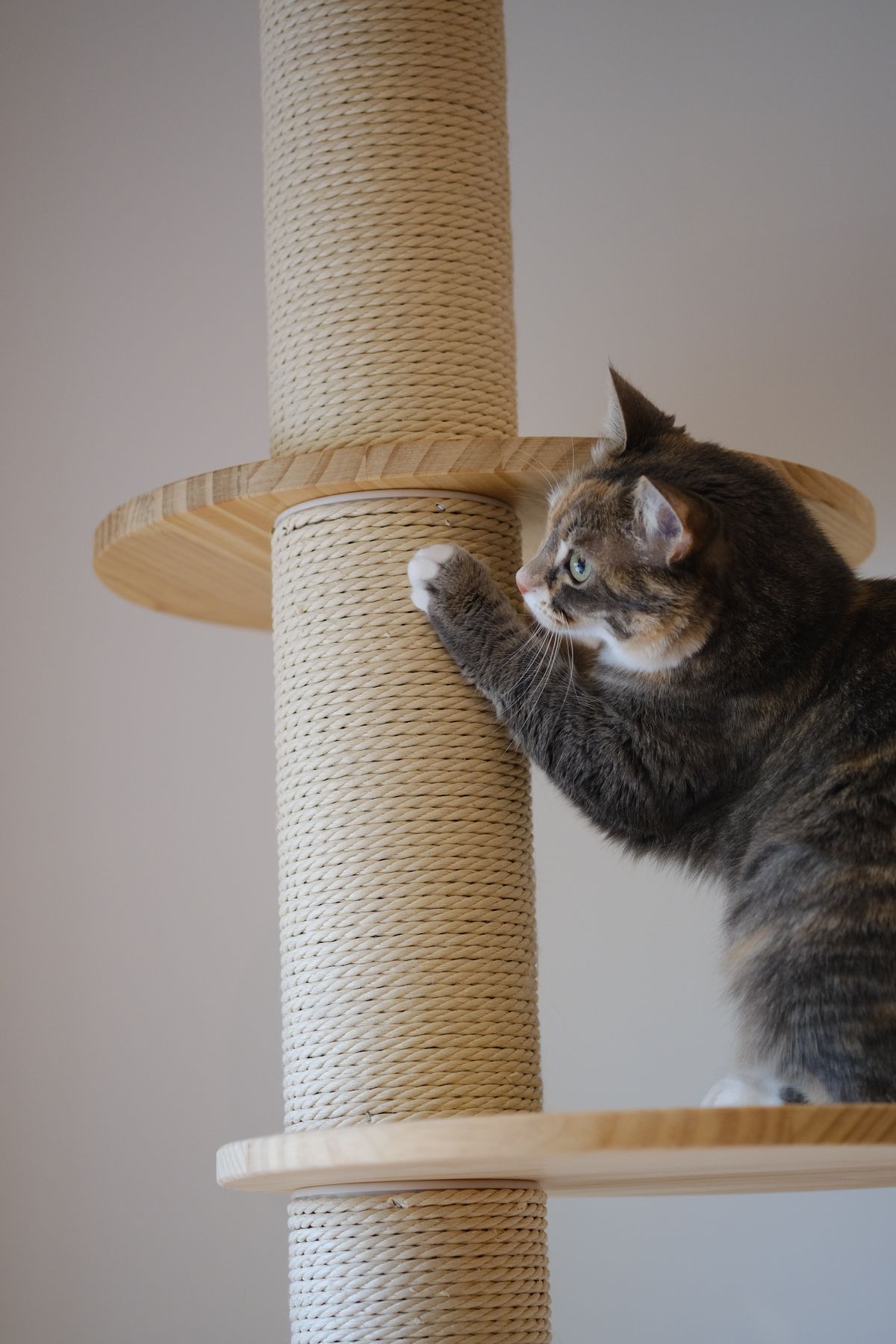
If your cat stretches upward against the sofa before scratching, choose a vertical post tall enough for a full-body stretch.
A tiny post may technically be a scratching post, but it may not satisfy the same physical need as the side of a sofa.
Stability matters even more
A scratching post that shakes, slides, or nearly falls over can quickly lose its appeal.
Furniture has an enormous advantage because it usually stays completely stable while the cat pulls against it. A good scratching post should offer similar resistance.
Experiment with texture
Common scratching materials include:
- Sisal rope
- Sisal fabric
- Corrugated cardboard
- Carpet-like material
- Wood
If your cat ignores one material, that does not mean the cat dislikes scratching posts in general. The texture may simply be wrong.
Placement Can Make or Break Your Plan
Putting the scratching post in a distant spare room while the cat scratches the living-room sofa is unlikely to work well.
During the retraining period, place an appropriate scratching surface directly beside or extremely close to the furniture your cat currently scratches.
This may not be the perfect location from a decorating perspective, but it gives the alternative a much better chance of being used.
A Step-by-Step Nighttime Scratching Plan
Instead of relying on one trick, combine environmental management with enrichment and positive reinforcement.
- Identify the favorite scratching location. Start with the exact sofa, chair, carpet edge, or other object your cat repeatedly targets.
- Match the scratching style. Use a vertical post for a vertical scratcher and a horizontal board or pad for a cat that scratches carpets or flat surfaces.
- Put the alternative beside the target. Do not expect your cat to walk across the house looking for the scratching post.
- Temporarily protect the furniture. A suitable furniture cover or other cat-safe surface protection can make the old location less rewarding while the new habit develops.
- Reward correct scratching. When your cat voluntarily uses the scratching post, calmly provide something the cat values, such as praise, play, or a small appropriate treat.
- Add interactive evening play. Give your cat an opportunity to chase and move before bedtime.
- Keep the routine consistent. Repeating the same strategy is usually more useful than trying a different method every night.
Use Evening Play to Reduce Unspent Energy
A useful nighttime routine can include interactive play before you go to bed.
Use a toy that allows your cat to chase, stalk, and pounce while keeping hands away from claws and teeth. The intensity and duration should suit your cat's age, mobility, and general condition.
For many healthy adult cats, several short play sessions can be easier and more engaging than one very long session.
After play, returning to a predictable household routine may help make the transition toward nighttime quieter.
Make the Sofa Less Attractive While Training
Management can protect your furniture while your cat learns where scratching is allowed.
Depending on the furniture and the cat, owners may use fitted covers, scratch guards, or other pet-safe barriers. Always make sure anything attached to furniture is safe and will not trap claws or create a hazard.
The important point is that furniture protection should be paired with an attractive alternative.
Simply blocking the sofa without providing somewhere appropriate to scratch may cause the cat to choose another piece of furniture.
Should You Punish a Cat for Scratching Furniture?
Punishment is generally a poor long-term strategy for normal scratching behavior.
Yelling, frightening the cat, or physically correcting the behavior does not teach the cat which surface should be used instead. It may also make the cat associate your presence with something unpleasant.
Focus instead on three things:
- Make the correct scratching location easy to access.
- Make the furniture temporarily less attractive or accessible.
- Reinforce appropriate scratching when it occurs.
Common Mistakes That Slow Progress
| Mistake | Better approach |
|---|---|
| Putting the scratching post far from the sofa | Initially place it beside the favorite scratching location. |
| Buying a small, unstable post | Choose a sturdy option that supports a full stretch. |
| Assuming every cat likes sisal | Test different safe scratching textures. |
| Punishing scratching | Redirect and reward appropriate scratching. |
| Giving attention every time nighttime scratching begins | Avoid accidentally creating a predictable attention-seeking routine while still managing the environment safely. |
| Changing the entire strategy every day | Use a consistent plan and monitor the overall trend. |
What If Your Cat Scratches the Bedroom Furniture?
If the scratching happens in your bedroom, look closely at placement.
A scratching surface near the sleeping area may be useful because some cats scratch after waking or during transitions between rest and activity.
If the cat repeatedly chooses a particular bed frame, chair, or dresser, position an appropriate scratching option close to that location rather than expecting a scratching post in another room to solve the problem.
What If Your Cat Scratches Before Breakfast?
Timing provides useful clues.
If scratching consistently happens shortly before the cat expects breakfast, your response may have become part of the routine.
For example, if scratching wakes you and you immediately provide breakfast, the sequence may become predictable:
Scratch furniture → human wakes up → breakfast appears.
Consider whether meal timing and your response are unintentionally reinforcing the behavior. Any changes to feeding schedules should still meet your cat's nutritional needs and normal household routine.
Give Your Indoor Cat More Appropriate Outlets
A scratching post is important, but enrichment goes beyond scratching.
Depending on your cat's preferences and your home, useful options may include:
- Interactive play
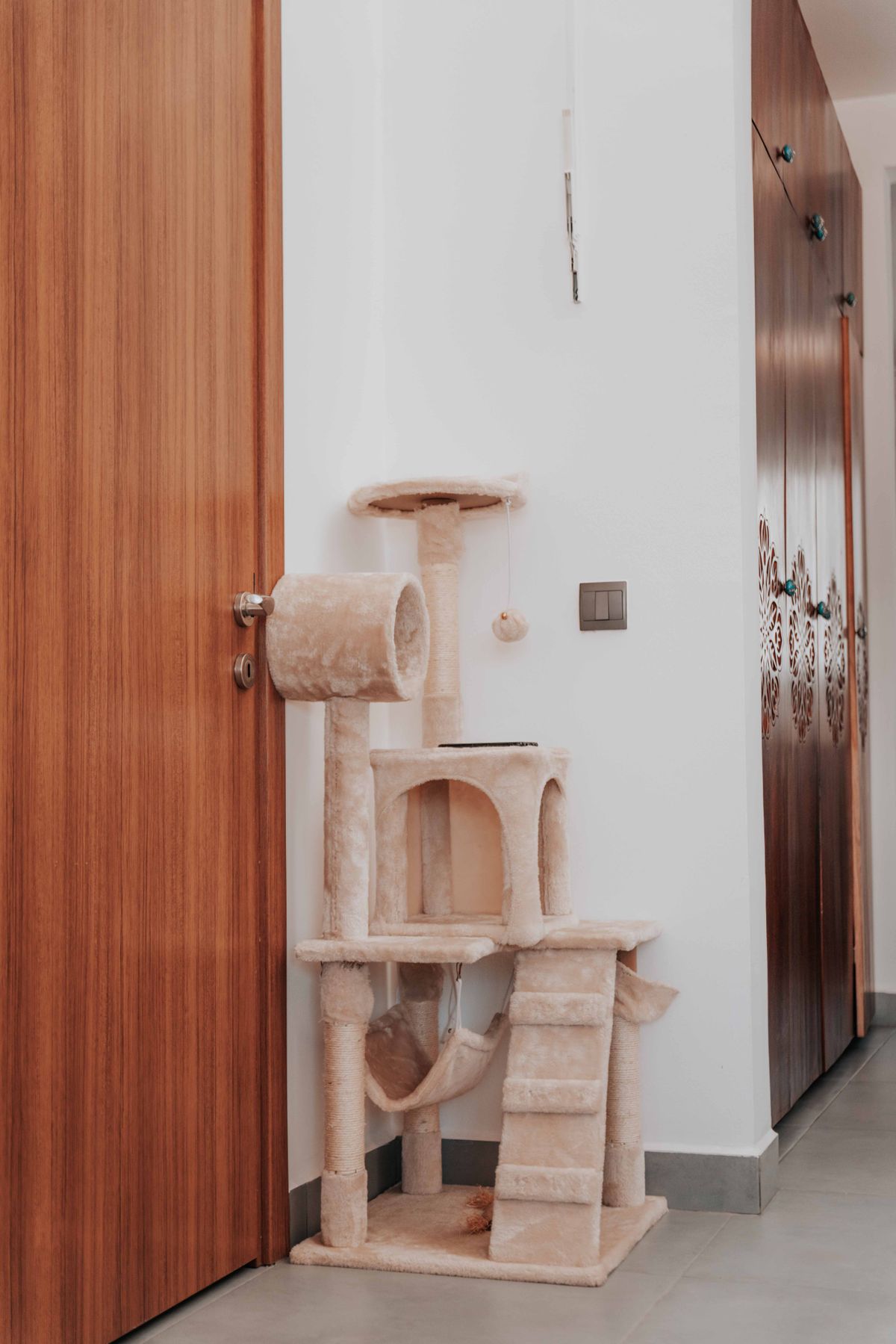
- Climbing areas
- Cat trees
- Window observation areas
- Food puzzles
- Cardboard scratching pads
- Safe hiding areas
- Rotating toys
- Quiet resting locations
You do not need to introduce everything at once. Start with a few useful changes and watch how your cat responds.
How Long Does It Take to Stop Furniture Scratching?
There is no universal timetable. Some cats begin using a well-positioned scratching post very quickly, while an established furniture-scratching habit can take longer to redirect.
Instead of judging success after one night, look for a trend.
Is the cat using the scratching post more frequently? Is damage to the sofa becoming less frequent? Are nighttime episodes becoming shorter or less common?
Those changes can indicate that your setup is moving in the right direction.
- Keep the preferred scratching post available.
- Keep it close to the problem area initially.
- Reward appropriate scratching.
- Maintain regular play and enrichment.
- Protect the targeted furniture during retraining.
- Track progress over several days rather than one night.
When Sudden Scratching Deserves More Attention
A normal scratching habit is different from a sudden major behavioral change.
If your cat unexpectedly starts scratching much more than usual, look at the broader picture. Consider recent household changes, new animals, visitors, altered routines, changes in access to rooms, or other environmental factors.
Also pay attention to physical and behavioral changes such as altered appetite, unusual vocalization, hiding, difficulty moving, litter-box changes, sensitivity to touch, excessive grooming, or other signs that your cat is uncomfortable.
A veterinarian can help rule out medical issues when a behavioral change is sudden, persistent, severe, or accompanied by other symptoms.
Frequently Asked Questions
Why does my cat only scratch the sofa at night?
Your cat may be more active at that time, may have developed a nighttime routine, or may prefer the sofa's location, stability, and texture. Observe exactly when scratching happens and place a suitable scratching surface beside the targeted area.
Why does my cat scratch furniture even though it has a scratching post?
The post may not match your cat's preferences. It could be too short, unstable, in the wrong location, or made from a texture your cat does not enjoy. Try to match the height, orientation, and texture of the surface your cat currently prefers.
Should I move the scratching post beside the sofa?
Yes, this can be a useful starting strategy. Positioning an appropriate scratching surface close to the established scratching location makes the alternative easier for the cat to choose.
Do cats scratch furniture because they are angry?
Scratching is a normal feline behavior and should not automatically be interpreted as revenge or anger. Cats scratch for physical, environmental, and communication-related reasons.
Will playing with my cat before bed help?
Evening interactive play can provide an appropriate outlet for activity and may be useful as part of a predictable nighttime routine. It should be combined with suitable scratching surfaces and environmental management rather than treated as the only solution.
Should I buy a vertical or horizontal scratching post?
Watch your cat. A cat that scratches sofa arms and other upright surfaces may prefer vertical scratching. A cat that scratches rugs or carpets may prefer a horizontal pad. Some cats benefit from having both.
Can I completely stop my cat from scratching?
The goal should not be to eliminate normal scratching. Instead, provide appropriate locations and redirect scratching away from household furniture.
When should I talk to a veterinarian?
Seek veterinary advice when scratching behavior changes suddenly, becomes unusually intense, or occurs alongside signs of pain, appetite changes, mobility problems, litter-box changes, excessive grooming, hiding, or other concerning symptoms.
Final Takeaway
Cat scratching furniture at night is frustrating, but the scratching itself is usually a normal behavior that needs a better outlet rather than punishment.
Start by identifying exactly where your cat scratches and what type of surface it prefers. Put a tall, stable scratching post or appropriate horizontal pad directly beside that location. Protect the furniture temporarily, reward use of the correct scratching surface, and add appropriate play and enrichment to the evening routine.
Most importantly, stay consistent. Your sofa has probably been an excellent scratching post from your cat's perspective for quite some time. Giving the cat an equally satisfying alternative—and making that alternative convenient—is much more likely to produce lasting improvement than repeatedly telling the cat to stop.
More Guides for Your Cat
Continue exploring PawPrintHub for practical guides about cat behavior, everyday care, enrichment, nutrition, and creating a comfortable indoor environment.
Comments
Post a Comment